

Written by: Abby Keeler, BS and Kayla Reed-Fitzke, PhD, LMFT
Data from the 2024 Active-Duty Spouse Survey (ADSS; Office of People Analytics, 2025) paint a story of military spouses’ experiences, which shapes our understanding of the needs and barriers they face. The survey is sponsored by the Office of Military Community and Family Policy (MC&FP) and administered by the Defense Personnel Analytics Center (DPAC) Office of People Analytics (OPA). The ADSS is conducted approximately every other year. This survey provides insight as to why spouses keep raising their hands, and where the ball may be dropped.
What Narratives are Emerging?
The first narrative appears to be a dual sense of progress and frustration. More spouses are in the workforce, but unemployment lingers. 69% of civilian spouses were in the labor force in 2024, which is a notable increase from 64% in 2021. However, the unemployment rate remained relatively flat at 20% in 2024 versus 21% in 2021. Spouses employed are still feeling underutilized. The underemployment score among employed spouses stayed at 2.9 (out of 5) on average, but more spouses reported that their pay wasn’t sufficient—57% in 2024 versus 52% in 2021.
Another salient narrative is that Permanent Change of Station (PCS) moves and childcare are still the biggest disruptors. About one in four military spouses experienced a PCS move in the last year alone, and 81% have experienced a PCS move during their spouse’s career. PCS moves are closely tied to employment disruption. If a military family made a PCS move within the past year, such a move increased the odds of spousal unemployment by 136% (Office of People Analytics, 2025). Notably, the average time since the last permanent change of station increased from 25.5 months in 2021 to 27.4 months, but many believe that number needs to increase.
In response, the Department of Defense (DOD) has taken on new initiatives to reduce the frequency and impact of PCS moves. Specifically, the DOD is tackling this issue on two fronts. The first initiative is military departments identifying and proposing ways to reduce their PCS budgets, in part by modifying some career development trajectories. This would facilitate some officers and noncommissioned officers to receive specialization in place and to be able to remain at their duty station for longer (Department of Defense, 2025). The second initiative is centered on reducing PCS frequency (Department of Defense, 2025). Currently, defense officials spend around $5 billion annually relocating service members and families (Adams, 2025).
In a May 2025 briefing, Tim Dill – formerly performing the Duties of Deputy Under Secretary of Defense for Personnel and Readiness – emphasized the urgency of this change, stating:
“It’s clear that it’s time for the department to look at reducing the frequency of those moves, especially if we want to maintain the momentum that we have today, both in recruiting and the retention of our service members” (Department of Defense, 2025).
To operationalize these goals, the DOD issued a PCS Targeted Reductions Review and Personnel Policy Changes memo (Office of the Under Secretary of Defense for Personnel and Readiness, 2025). The memo directs military departments to develop detailed, holistic implementation plans to reduce “discretionary” PCS moves, such as rotational, operational, and training-related relocations. Ultimately, the aim is to enhance stability for military families, promote long-term retention, improve department efficiency, and better align resource allocation with core functions.
Finally, the ADSS indicated 67% of military spouses have children under 18 living at home, which can make finding employment extremely difficult without accessible and affordable childcare. The survey indicates caring for a child(ren) not in daycare or school is a prime reason many aren’t seeking work. Below is a more detailed graphic showing the extent of child-related problems due to a PCS move:
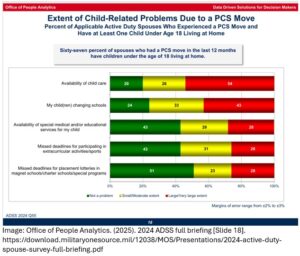
One can easily surmise that a PCS move and/or lack of childcare can lead to unemployment and increased financial strain. These economic factors are critical for military spousal well-being. According to the survey, spouses who reported not being financially comfortable and/or being unemployed on the ADSS survey also are most likely to report mental health distress.
What Can Providers Do Now?
- Proactively share resources-especially about employment and financial assistance.
- Educate spouses on remote-first careers and flexible roles that travel with them.
- Connect families with Child Development Center waitlists as early as possible.
- Share information regarding local, vetted childcare options and fee assistance programs.
- Address stress/anxiety that stems from financial and employment instability.
- Assist spouses in reframing employment gaps as temporary setbacks-not permanent limitations.
- Encourage spouses to engage with groups advocating for changes in PCS policy.
- Empower spouses to track employment and PCS issues to strengthen their role in shaping future policies.
Final Takeaway: Support Spouses, Strengthen the Force
The story emerging from ADSS 2024 is clear: military spouses are ready and willing to work, but the system isn’t keeping up. Families are juggling PCS disruptions, childcare barriers, and underemployment, all while trying to stay financially afloat. These challenges aren’t just personal frustrations – they directly impact military readiness and retention.
In the meantime, while policy reform is in motion, change can’t come fast enough for military families. Policy conversations sparked by surveys like the ADSS could reshape spouse employment in meaningful ways. However, military families can’t wait years for solutions. Providers and community leaders play a critical role. Providers are the bridge between today’s challenges and tomorrow’s systemic change. In the end, the ADSS reminds us that supporting military spouses is supporting the force itself.
References
Adams, M. (2025, May 28). Pentagon budget for personnel moves could be cut in half by 2030. Stars and Stripes. https://www.stripes.com/theaters/us/2025-05-28/military-moves-pentagon-budget-cuts-17940790.html
Department of Defense. (2025, May 28). Performing the duties of Deputy Under Secretary of Defense for Personnel and Readiness: Off‑camera, on‑the‑record briefing on permanent change of station targeted reductions review and personnel policy changes [Transcript]. U.S. Department of Defense. https://www.defense.gov/News/Transcripts/Transcript/Article/4199789/performing-the-duties-of-deputy-under-secretary-of-defense-for-personnel-and-re/
Office of People Analytics. (2025). 2024 Active-Duty Spouse Survey [PDF]. https://download.militaryonesource.mil/12038/MOS/Presentations/2024-active-duty-spouse-survey-full-briefing.pdf
Office of People Analytics. (2023). 2021 Active-Duty Spouse Survey [PDF]. https://download.militaryonesource.mil/12038/MOS/Presentations/2021-active-duty-spouse-overview-briefing.pdf
Office of the Under Secretary of Defense for Personnel and Readiness. (2025, May 22). Permanent Change of Station targeted reductions review and personnel policy changes [Memorandum]. U.S. Department of Defense. https://media.defense.gov/2025/May/28/2003725100/-1/-1/1/PERMANENT-CHANGE-OF-STATION-TARGETED-REDUCTIONS-REVIEW-AND-PERSONNEL-POLICY-CHANGES.PDF
Photo Credit: tashatuvango | Adobe Stock 245345180