Written by: Lisa A. Kramer, Ph.D
It never failed. When going over the projects for my courses at any college/university on the first day of class, groans would echo through the space, and eyes would roll when we came to the inevitable group project.
Yet I assigned them every semester—whether the class was in theater, writing, first-year studies, or anything else. Students would argue as they thought their grades would suffer if they didn’t work alone. I built in measures to ensure that those who did the work got more credit than those who did not. This often included having group members assess other members in a “for my eyes only” assessment. But that wouldn’t really ease their tension.
Why Group Projects
Why did I do this? In a world where a lot of communication now occurs hidden safely behind the protection of screens and technology, it seems more important than ever to develop a way to work with others in groups where people can use their strengths, while also being open to other opinions. It’s important to learn how to listen to new ideas and incorporate others’ ideas to achieve common goals.
This is a skill that can be developed in classrooms and also practiced and improved upon in any group situation. From boardrooms to collaborative community projects across disciplines, to attempting to solve problems in a world where different stakeholders have differing goals—we need to better learn to communicate, collaborate, cooperate, and innovate with all the voices in the room.
As an educator, my goal was always to democratize learning by allowing and encouraging students to approach ideas and projects with their needs in mind, while also embracing the different opinions in the room. I found group projects a good way for them to reinforce these collaborative lessons that always start with a circle.
The Power of Circles
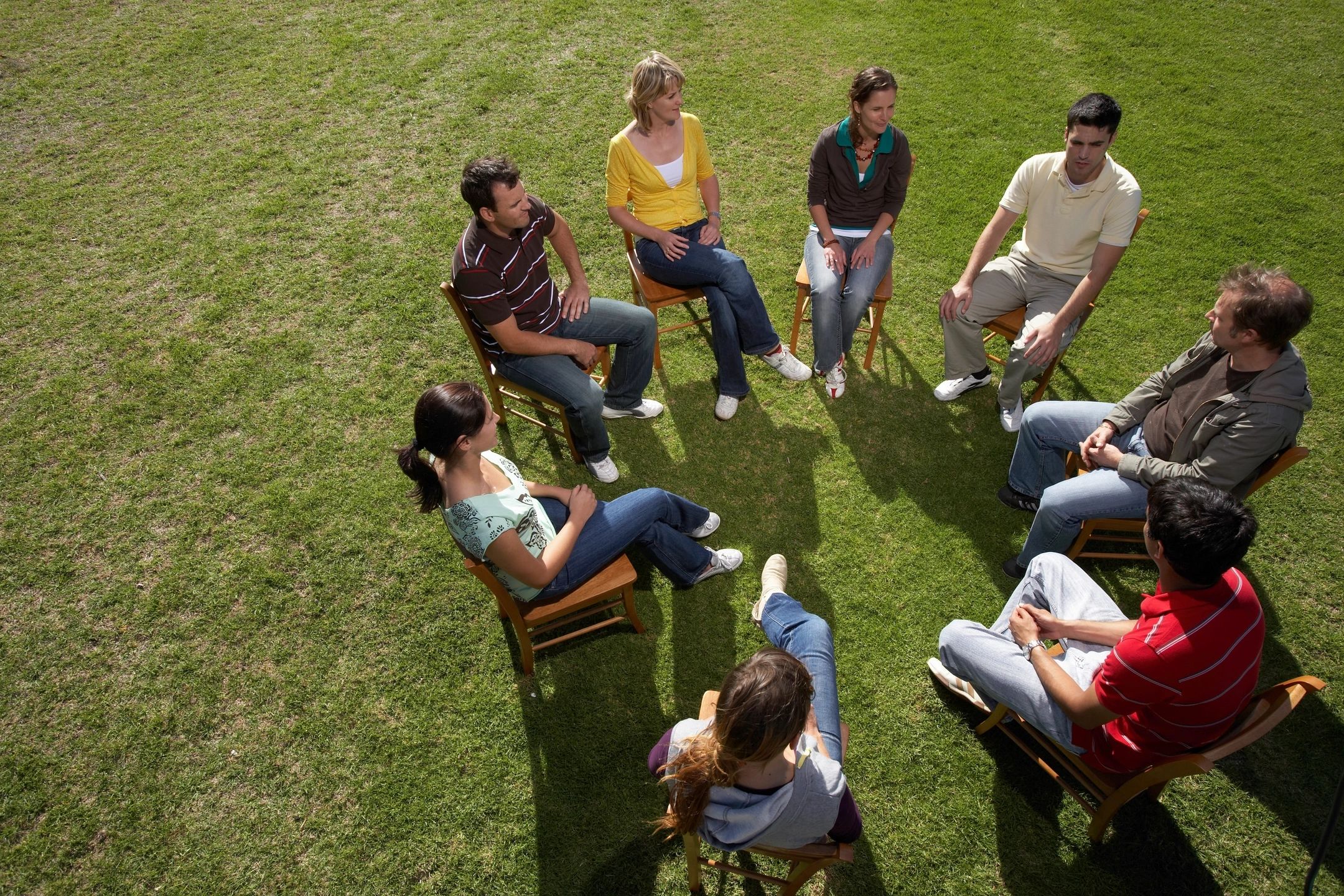
When I have the option, whether in a classroom or leading a workshop somewhere, I will try to move people into a circular formation.
The circle is one of human history’s oldest and most fundamental shapes. The exact origin of the circle is unknown, though it is thought to have been used by ancient civilizations as a symbol of unity, perfection, and infinity. Fast forward to the present day, and the circle remains a powerful symbol of wholeness and interconnectedness. The connection to circle processes lies in the symbolic significance and practical applications of the circle shape. It represents unity, equality, inclusivity, non-hierarchical structure, dialogue, collaboration, energy flow, and harmony. (Valree 2023)
I do this because, as a leader, I choose to be democratic, allowing the voices and the ideas of all participants to have equal value in the room. I acknowledge that I may have more experience or knowledge about a topic, but I emphasize that I always have something to learn. A circle allows participants to see me as a co-creator rather than an autocrat.
After all, creativity and innovation come when we let go of complete control and explore other options. Jennifer Mueller, author of Creative Change: Why We Resist It . . . How We Can Embrace It, “[b]elieves that people miss creative ideas because of what she calls the how/best mindset—one marked by an intolerance of uncertainty and a concern with being right.” (Suttie 2017). This can often happen in group projects because someone comes in with a focus on the letter grade and being right, rather than the process of co-creating something with the team.
From day one in my courses and workshops, I strive to be a co-creator rather than a top-down educator. I model this by leading discussions in a circle; encouraging breakout groups that are always mixed up, and assigning one group project where they learn to navigate their individual abilities toward a final goal. Of course, using this approach means that I must let go of the expectation of the perfect product, and yet every product that comes from this process is perfect in its own way because it is creative, innovative, and represents the voices of all participants. “Cultivating curiosity, being open to uncertainty, and being willing to imagine the potential benefits of an idea can help embrace innovation, [Mueller] writes” (Suttie 2017).
Democratizing the Process
We all know that group projects often lead to an inequity of labor distribution. The leaders and the doers take on much of the work, and others will either slide in late or take credit at the end. Or there might be the person who takes on the supervisor role while everyone else does most of the work. A breakdown of group roles found in Social Science LibreTexts outlines group roles in this way (Green, et al., n.d.):
- Task Roles
- Information/Opinion giver
- Information/Opinion Seeker
- Analyzer
- Idea Person
- Expediter
- Recorder
- Producer
- Social Maintenance Roles
- Energizer
- Supporter
- Gatekeeper
- Harmonizer
- Tension Reliever
- Negative Roles
- Monopolizer
- Aggressor
- Withdrawer
- Social loafer
- Joker
- Abdicator
Understanding these roles can provide a foundation for group formation. For my group projects, I would list specific task roles that had to be fulfilled to accomplish the project. At the same time, I would take on social maintenance roles so that I could adjust if someone played a negative role in a group, or if someone was taking too much control.
How do I do this? By merging to leadership styles: Laissez-faire and democratic:
- Laissez-faire means to let things take their own course. The laissez-faire leader does nothing without being directed to do so by the group. [. . .]
- A democratic leader will take more initiative, but knows the power remains with the group. They will assume whatever they do on behalf of the group has to be supported by the group. [. . . ] They are leading on procedural matters but leaving the decision to the group. It is a balance between taking initiative yet respecting the authority of the group. (Green, et al. n.d.)
In other words, I encourage groups to explore, imagine, and make mistakes, but I will step in if everything becomes too chaotic.
There is no one right way to solve problems when working with people who have different goals. However, by trusting the process and valuing the voices of all participants, you may discover unexpected solutions.
It all begins with a circle.
References
Green, Keith, Ruth Fairchild, Bev Knudsen, and Darcy Lease-Gubrud. “2.1.1: Elements of a Group.” LibreTexts Social Sciences. n.d. https://socialsci.libretexts.org/Workbench/Mediated_Oral_Communication/02%3A_Small_Group_Communication_Online/2.01%3A_Small_Group_Communication/2.1.01%3A_Elements_of_a_Group.
Suttie, Jill. “Why Your Creative Ideas Get Ignored.” Greater Good Magazine. March 3, 2017. https://greatergood.berkeley.edu/article/item/why_your_creative_ideas_get_ignored.
Valree, Renata. “Building Peaceful Communities: The Power of Circles in Schools.” NAFCM.org. June 30, 2023. https://www.nafcm.org/news/644980/Building-Peaceful-Communities-The-Power-of-Circles-in-Schools-.htm#.